A predator-prey interaction between two species occurs when one species (the predator) feeds on a second species (the prey), while the second species uses natural resources as unlimited food supply. Interest in using mathematics to help explain predator-prey interactions has been stimulated by the observation of population cycles in many mammals. In the MacKenzie River district of Canada, for example, the principal prey of the lynx is the snowshoe hare, and both populations cycle with a period of about 10 years.
The first mathematical model for predator-prey interactions was proposed by A. Lotka (1925) and V. Volterra (1926). Suppose x(t) denote the number of prey in time t and y(t) denote the number of predators. The Lotka-Volterra model takes the form:
There are four positive parameters of the model: a,b,c, and d. The parameter a is the growth rate of prey in the absence of predators, when y = 0. The popoulation of prey grows exponentially because of the assumption of unlimited (natural) food supply for prey. The parameter c is the death rate of predators in the absence of prey, when x = 0. The population of the predator decays exponentially because of the shortage of their food supply (that is prey). The parameter d represents the death rate of prey due to predation. Our assumption is that the death rate is proportional to the number of possible encounters xy between prey and predator at a particular time t. The parameter c represents the growth rate of the predator due to predation, the growth rate is also proportional to the number of possible encounters xy.
Both the population levels x(t) and y(t) are assumed to be positive, i.e. solutions to the Lotka-Volterra model are considered only in the first quadrant of the phase plane (x,y). There are two equilibrium points in the model: (i) zero equilibrium at x = y = 0 and (ii) non-zero equilibrium at x = d/c and y = a/b. The zero equilibrium is clearly unstable, since the population of prey may grow exponentially. The non-zero equilibrium is likely to be stable since it represents the dynamical balance between populations of prey and predator.
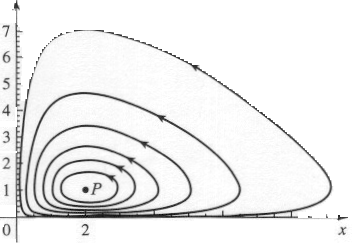
Analysis shows that the zero equilibrium (i) is indeed an unstable saddle critical point of the dynamical system. The non-zero equilibrium (ii) is locally stable as the center point. Typical trajectories on the phase plane (x,y) are shown here:
All trajectories in the first quadrant that originate at a non-critical initial point are closed. The predator-prey interaction model has only periodic solutions. These periodic solutions describe predator-prey population cycles about the non-zero equilibrium between their population levels in balance.
You are suggested to check these conclusions by running numerical simulations of the predator-prey software demo. The following simulations and questions are recommended: